Probabilistic Inertial Poser

Wearable Inertial Measurement Units (IMUs) allow nonintrusive motion tracking, but limited sensor placements can introduce uncertainty in capturing detailed full-body movements. We introduce the Probabilistic Inertial Poser (ProbIP), a novel probabilistic model that transforms sparse IMU data into human motion predictions without physical constraints. ProbIP utilizes RU-Mamba blocks to predict a Read more
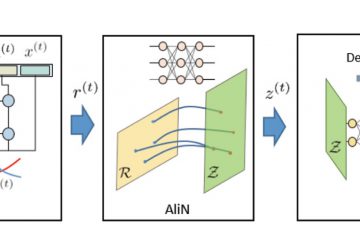
Vision-based Intention Detection for Hand Rehabilitation

For stroke survivors, diminished hand functions limit their ability to perform Activities of Daily Living (ADLs). To help stroke survivors perform rehabilitation exercises, soft robotic gloves have been utilized to assist them in actively practicing hand movements based on intentions expressed through biosignals, such as electromyogram and electroencephalogram. While practicing Read more

Human sensory intelligence with meta learned substrate-less nanomesh receptor

We report a substrate-less nanomesh receptor that is coupled with an unsupervised meta-learning framework and can provide user-independent, data-efficient recognition of different hand tasks. The nanomesh, which is made from biocompatible materials and can be directly printed on a person’s hand, mimics human cutaneous receptors by translating electrical resistance changes Read more

BT-LSTM for fingertip force estimation of soft hand robot

Soft wearable hand robots with tendon-sheath mechanisms are being actively developed to assist people with lost hand mobility. For these robots, accurately estimating fingertip forces leads to successful object grasping. An approach can utilize information from actuators assuming quasi-static environments. However, non-linearity and hysteresis with regards to the dynamic changes Read more

Augmented Intelligence for Wearable Soft Robot

Developing Soft Robotics To Assist Users With Hand-Object Interactions [의도 파악하는 웨어러블 손 로봇 관련 기사들]   For hand robots that assist with activities of daily living, this study presents a paradigm for learning-based intention detection based methodologies that perceive user intentions for wearable robots, by utilizing a first-person-view camera. We Read more